

Ushering in a new era: That’s my dramatic way of saying I’ve finished reading a book, only my third this year, and I’m about to dump some quotes on you before moving on to my next read.
The novel: The Blind Assassin (2000) by Margaret Atwood
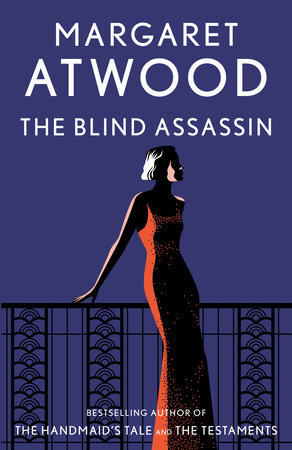
My Hot Take
No prior research or review-reading having been done. Yup, mild spoilers.
Would re-read for sure, despite almost giving up on the book several times for its constant dishing of devastation. Tragedy strikes from the outset, and the reader quickly loses hope in an uphill trajectory; even my natural attraction to melancholia could barely stand up to this. I mainly struggled to invest in the tertiary story beneath it all, the closest to sci-fi/genre fiction referred to in the marketing of this book, as well as the closest thing to salvation for the characters, but I trudged on, aided by my historical love for bleak, Bronte-esque sagas of upper-echelon families residing in castles and mansions riddled with secrets of inconceivable shame, set atop acres of isolation.
You see, it's in my DNA to pick up a Gothic drama like this. Take that, free will. Which brings me to the central conflict that is both the curse and the purpose of the plot. As you'll see underlying several of the quotes I've selected from the book, Atwood's main challenge here was to present the protagonist's realistic dearth of mobility (socially, then later on, physically), while still moving the plot along. You realize that a lot of what creates change in most Gothic novels is the actions of men, or the births and death of family members, and here, Atwood challenges that, but not by turning females into heroines moving mountains. But by placing us in the hands of an ordinary, sometimes clumsy, utterly human character, confronting us with all that she does or doesn't do, which illustrates the common course that life takes for many midcentury, and even modern, women, and the rich inner world that emerges in response to unrealized dreams, unspoken desires, unexplored path. Iris could have been any of those high-society wives posing beside their husbands in those sepia family portraits lining the walls of historical homes that people tack onto a random day trip--painfully aware of the lives she has not led but not foolish enough to reveal it, not Hollywood enough to act out.
Setting the Mood(board)
Besides the mansion setting I’ve described above, imagine bundling up with a doughnut on a public bench overlooking a thawing river running through an old Ontario town marked by brick buildings and rusty cars beaten down by decades of pummeling from ice and snow– the one setting in this book that you and I would most identify with, minus the protagonist’s inability to finish a whole doughnut, but I’ll give her a pass due to her advanced age and compromised health.
Think stained stairwells in dimly lit hotels where lover rendezvous, the warm gas lamps in their makeshift quarters illuminating the smoke and the worries drifting off a young man’s cigarette, back when they all smoked cigarettes, as his lover looks up and pictures the rounded ceiling blending into that of a torch-lit castle turret atop a medieval spaceship. Wool clothing strewn about the room.
Passages to Keep
In order of appearance (mild spoilers ahead):
- Re: inheriting the family business: “They did not set out to disappoint their father, not on purpose, but neither did they wish to shoulder the lumpy, enervating burden of the mundane” (78).
- On nursing a vulnerable love interest back to health and the inevitable development of ulterior motives + re: women’s roles: “She wished him to owe his recovery to her alone – to her care, to her tireless devotion. That is the other side of selflessness: its tyranny” (93).
- On a marriage sullied by war-induced PTSD: “It was as if they’d drunk some fatal potion that would keep them forever apart, even though they lived in the same house, at at the same table, slept in the same bed.
What would that be like–to long, to yearn for the one who is right there before your eyes, day in and day out?” (94).
—To be totally transparent, this captures my most recent romantic dabbling most aptly but without the auspicious beginnings that marked the marriage she describes. Rather, my relationship revealed its flaws from the outset, but it is still devastating to confront the limits of desire; that no matter how much you want to connect, a whole culmination of circumstances makes it impossible, makes the act of trying damaging to one’s being in some manifestation or another. For me, it was the feeling of not being me, or that “me” would not mesh with “us.” When two people have such incompatible experiences of the world, yet like each other enough to show up–that’s when I get angry at the powers outside of our control. I don’t know. There are only so many people who cross paths with us who stick around, and I believe they both came from and become a part of us–i.e., there are no mistakes.
- On being the easygoing sibling/family member who escapes the radar: “I should have screamed. I should have thrown tantrums. It’s the squeaky wheel that gets the grease, as Reenie used to say.”
- Re: redefining oneself as a female in the 1920s defined by her father’s success in the impactful but unremarkable button-making industry: “I was stuck in Port Ticonderoga, proud bastion of the common-and-garden-variety button and of lower-priced long johns for budget-minded shoppers. I would stagnate here, nothing would ever happen to me, I would end up an old maid like Miss Violence, pitied and derided. This at bottom was my fear. I wanted to be elsewhere, but I saw no way to get there” (207).
- An excerpt from one of the protagonist’s textbooks as a child: “‘Cookery means the knowledge of Medea and of Circe and of Helen and of the Queen of Sheba. It means the knowledge of all herbs and fruits and blams and spices, and all that is healing and sweet in the fields and groves and savory in meats. It means carefulness and inventiveness and willingness and readiness of appliances. It means the economy of your grandmothers and the science of the modern chemist; it means testing and no wasting; it means English thoroughness and French and Arabian hospitality; and in fine, it means that you are to be perfectly and always ladies– loaf givers’” (216) …As opposed to the famous taker, Jean Valjean? The last bit there certainly undoes the effect of the whole passage, which charmingly evokes the cultural, full-body experience of cooking.
Just a gut-wrenching, beautiful passage:
“Why does she keep arriving? Is he some private game she’s playing, is that it? He won’t let her pay for anything, he won’t be bought. She wants a love story out of him because girls do, or girls of her type who still expect something from life…
Better not invent her in her absence. Better to wait until she’s actually here. Then he can make her up as she goes along.”
(Atwood, 332).
Even better paired with a line several chapters later: “She imagines him imagining her. This is her salvation” (493).
- “Placidity and order and everything in its place, with a decorous and sanctioned violence going on underneath everything, like a heavy, brutal shoe tapping out the rhythm on a carpeted floor” (448).
- “Does naming a sphere of nothingness transmute it into being?” (375).
“But her mind can’t hold him, she can’t fix the memory of what he looks like. It’s as if a breeze blows over the water and he’s dispersed, into broken colours, into ripple; then he reforms elsewhere, past the next pillar, taking on his familiar body. Around him is a shimmering. The shimmering is his absence, but it appears to her as light. It’s the simple daily light by which everything around her is illuminated” (Atwood 500).
People disperse into mere ideas. Memories. We project ourselves onto them and force them to fill the gaps in our lives regardless of their qualifications to do so, because no better alternative could be found. Because we are resourceful creatures who build imaginary kingdoms out of scraps, for fear that the only alternative is destruction. Or stagnation.
- In trying to explain her daughter’s self-inflicted spiral of addiction and depression: “An unearned income encourages self-pity in those already prone to it” (524).
- “I wonder which is preferable – to walk around all your life swollen up with your own secrets until you burst from the pressure of them, or to have them sucked out of you, every paragraph, every sentence, every word of them, sol at the end you’re depleted of all that was once as precious to you as hoarded gold, as close to you as your skin…” (541). This goes on, but is an example of an impeccable, roiling compound sentence on steroids. Love it so.
- “But it’s only an invention, all of this. It’s only another dimension of space. Why then is there such desolation?” Why, indeed, are we here?? As is emphasized with profundity in the show I’m currently in the middle of, Ricky Gervais’s After Life, the world goes on because people grow trees knowing they won’t live to enjoy them.
Words employed by Atwood that I wish to incorporate more:
subterfuge, munificence, perfidious, sibilant, ersatz, impertinence, desultory, aplomb, tawdry, stultifying, rancor, bilious, ESCARPMENT!!!
That’s all for now, folks. Have I convinced you to read The Blind Assassin? Do you have thoughts/reviews/other material you’d like to share on the topic? Or, wanna talk about After Life? (So good so far!) Comment below, and let’s strike up a convo.
Cited:
Atwood, Margaret. The Blind Assassin. New York, Anchor Books, September 2001.

